
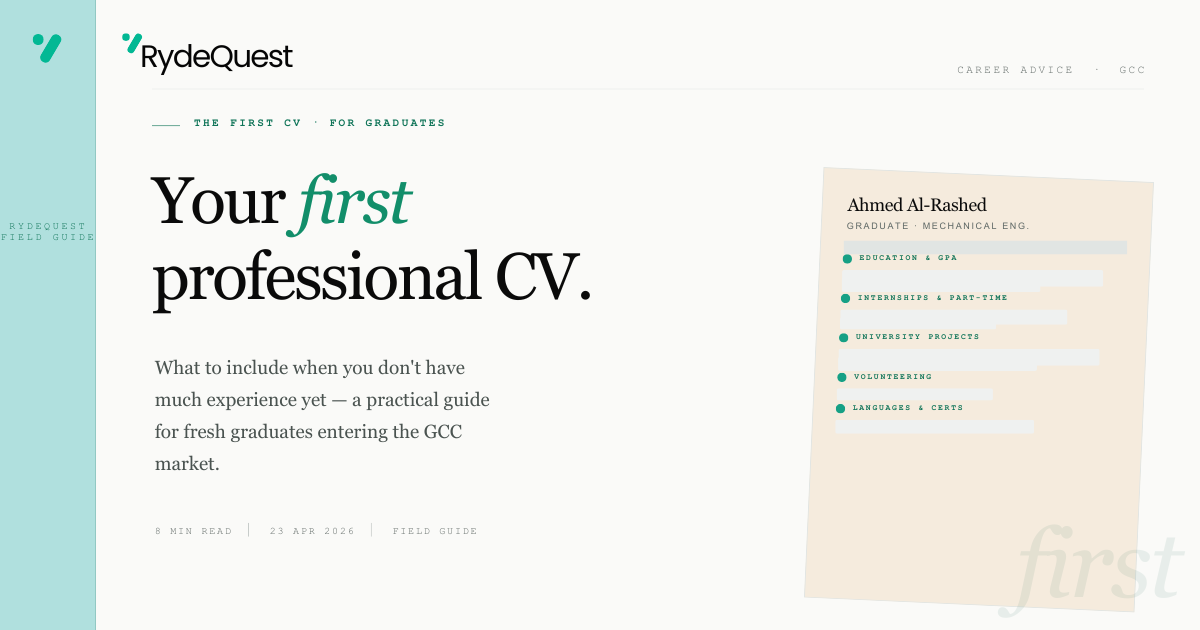
Your First Professional CV: What to Include When You Don't Have Much Experience Yet
Starting your career is exciting — but staring at a blank CV document? That part is less fun. If you've just graduated, recently completed an internship, or are applying for your first real role, you've probably hit the same wall: What do I actually put on here?
The good news is that every senior leader you admire once had an empty CV too. And recruiters who work with early-career candidates aren't expecting decades of experience — they're looking for signs of potential, professionalism, and self-awareness. Here's how to build a CV that shows all three.
Start With Structure, Not Content
Before you write a single word, get your sections in the right order. For someone early in their career, your CV should follow this layout:
- Contact Information
- Profile Summary (2–4 lines about who you are and what you're looking for)
- Education
- Internships / Work Experience
- Skills
- Extracurriculars, Volunteering, or Projects (if relevant)
- Languages (especially important in the GCC)
- Certifications (if any)
Notice that Education comes before Work Experience. That's intentional. When you're early in your career, your degree, institution, and academic achievements are your strongest signal — lead with them.
What to Include When Your Work History Is Thin
Internships count — treat them like real jobs
Even a one-month internship belongs on your CV if you did real work. Write it the same way you would a full-time role: company name, your title, dates, and 2–3 bullet points describing what you actually did. Focus on tasks, tools used, and anything you contributed to — not just that you "assisted" or "supported."
Weak: Assisted the marketing team with daily tasks.
Strong: Supported the social media team in scheduling content across Instagram and LinkedIn, contributing to a 12% increase in post engagement over six weeks.
See the difference? One is vague. The other shows you were paying attention and can quantify impact.
University projects and dissertations are fair game
Did you complete a final-year project, research paper, or group case study that's relevant to the role you're applying for? Include it. A well-described academic project can demonstrate analytical thinking, initiative, and subject-matter interest — all things employers value in junior candidates.
Volunteering and extracurriculars reveal character
Captained a university sports team? Organised an event for a student society? Volunteered at a community initiative? These experiences say something about your work ethic, teamwork, and how you show up — qualities that are hard to teach. Don't undersell them.
Part-time jobs and family business experience count too
Worked at a café, retail shop, or helped run a family business during your studies? Include it. Customer-facing roles demonstrate communication skills, reliability, and the ability to work under pressure — all genuinely valued by employers.
What to Leave Off
- A photo — in most GCC markets, a photo is optional and increasingly unnecessary. When in doubt, leave it out unless the job posting specifically requests one.
- Your nationality or religion — not required and not relevant.
- References — simply write References available upon request if you need to address it at all. Most employers will ask if they need them.
- Every subject you studied — listing your modules wastes space. Mention your degree, your institution, your graduation year, and your grade or GPA if it's strong.
- An "Objective Statement" that's all about what you want — your profile summary should focus on what you offer, not just what you're hoping to get.
Keep It Clean and Easy to Read
A cluttered CV signals disorganised thinking. A clean, readable one signals exactly the opposite. A few formatting principles to follow:
- Use a single, professional font — Arial, Calibri, or Garamond work well. Avoid anything decorative.
- Keep font size between 10–12pt for body text; slightly larger for your name and section headings.
- Use consistent formatting — if one job title is bold, they should all be bold.
- Leave white space — margins and spacing make your CV easier to scan. Don't cram everything in.
- Save as a PDF — unless the employer specifically asks for a Word document, PDF is the professional standard. It preserves your formatting across all devices.
One Final Thought
Your first CV will not be perfect — and it doesn't need to be. What it needs to do is clearly communicate who you are, what you've done so far, and why you're worth a conversation. Focus on honesty, clarity, and showing that you've made the most of the opportunities you've had.
Every great career starts somewhere. Yours starts here.
RydeQuest is a boutique executive search and HR advisory firm based in Abu Dhabi, serving organisations across the GCC. Follow us for more career insights, or get in touch at rydequest.com.