
How to Write a CV Summary That Actually Gets You Noticed
By RydeQuest | Career Advice for Young Professionals in the GCC
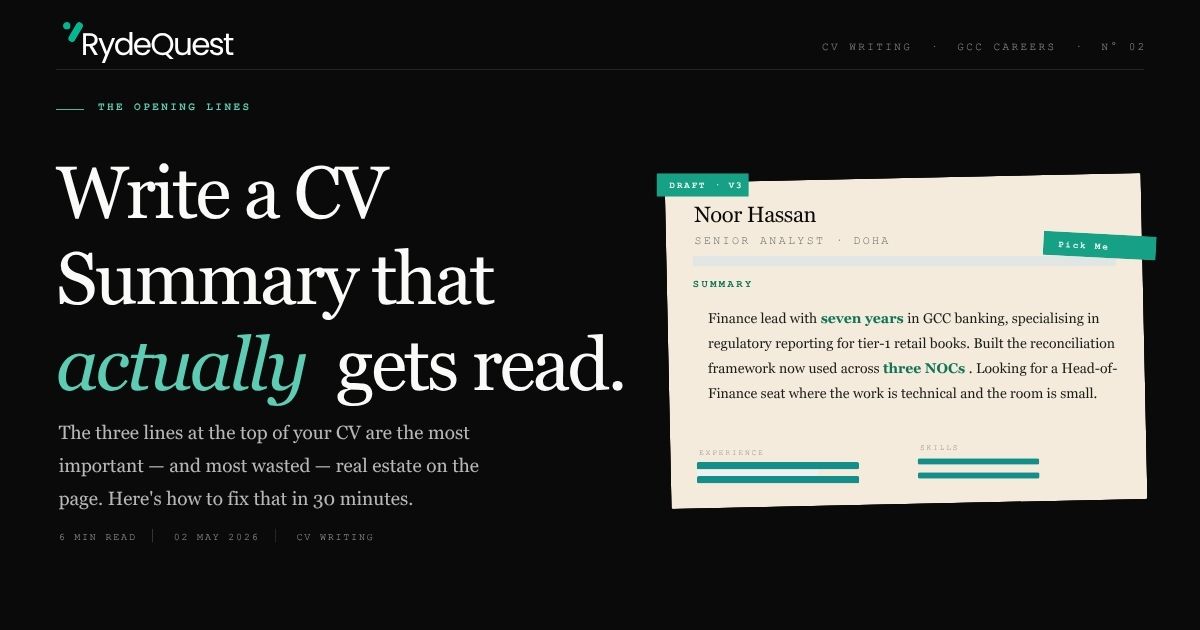
There are four lines at the very top of your CV — just below your name and contact details — that most job seekers completely waste.
The Cover letter is your first and sometimes only chance to tell a recruiter or hiring manager who you are before they scan the rest of the page. Done well, it pulls them in. Done badly — and it usually is done badly — it blends into every other CV in the pile and gives the reader no reason to keep reading.
Here's how to write one that actually does its job.
Why Most CV Summary Fail
Open any CV from a recent graduate or junior professional, and you'll likely find something like this:
"A hardworking, motivated, and enthusiastic recent graduate with strong communication and teamwork skills, looking for an opportunity to grow and contribute to a dynamic organisation."
Sound familiar? This summary says almost nothing. It's packed with adjectives that every candidate uses, none of which can be verified, and it focuses almost entirely on what the candidate wants — not what they offer.
Recruiters see hundreds of CVs. A summary like this is invisible. Worse, it can make you seem like you've put no real thought into your application.
What a Good CV Summary Does
A strong profile summary does three things in 3–4 concise lines:
- Tells the reader who you are — your background, your field, your level
- Signals what you bring — a key skill, achievement, or area of expertise
- Points to where you're headed — the type of role or environment you're seeking
It should be specific enough to feel personal and tailored, but flexible enough to work across similar roles. Think of it as your professional headline — the thing that makes someone want to read the rest.
A Simple Formula to Get You Started
If you're not sure where to begin, try this structure:
[Who you are] + [your strongest relevant skill or experience] + [what you're looking for or what you want to contribute]
For example:
"Finance graduate from the American University of Sharjah with hands-on experience in financial modelling and data analysis from a summer internship at a regional bank. Seeking a junior analyst role where I can contribute to investment decision-making in a fast-moving environment."
That's three lines. It names the degree, the institution, a specific skill, a real experience, and a clear direction. It's not flashy — it's just clear. And clear is exactly what busy recruiters need.
Tailoring Your Summary for the GCC Market
The GCC job market has some nuances worth knowing when writing your summary. Employers across the UAE, Saudi Arabia, Qatar, and the wider region tend to value:
- Multilingualism — if you're fluent in Arabic and English, say so in your summary. It's a genuine differentiator.
- Cultural awareness — phrases that signal you understand the local business environment can resonate well.
- Sector awareness — if you're targeting Financial Services, Real Estate, or Government roles specifically, name it. Generic summaries suggest unfocused applications.
Example for a bilingual candidate targeting the UAE:
"Bilingual Arabic and English communications graduate with experience producing digital content for a UAE-based media outlet. Strong understanding of the regional media landscape and audience behaviour. Looking to join a corporate communications or PR team in Dubai or Abu Dhabi."
Specific. Relevant. Regionally aware.
Words to Avoid
Some adjectives have been so overused on CVs that they've lost all meaning. Strike these from your summary:
- Hardworking
- Motivated
- Enthusiastic
- Dynamic
- Team player
- Passionate
- Results-driven
- Self-starter
None of these are bad qualities — but they can't be verified, and every candidate claims them. Replace them with evidence. Instead of saying you're "results-driven," describe a result. Instead of "team player," mention a collaborative project. Show, don't tell.
Keep It in Third Person — Without the Pronoun
One small technical note: CV summaries are typically written in the third person without using "I." This creates a more professional, objective tone.
Instead of: "I am a recent marketing graduate who is passionate about brand strategy..."
Write: "Marketing graduate with a focus on brand strategy and consumer insight..."
It reads cleaner and sounds more confident.
Rewrite It for Every Application
Your summary is the part of your CV most worth customising per role. It should take no more than five minutes to adjust — swap in a relevant skill, echo a word from the job description, or shift your stated goal to align with the company's focus.
A summary that speaks directly to the role you're applying for will always outperform a generic one. Hiring managers can tell the difference.
A Quick Checklist Before You Submit
Before you send your CV, read your summary and ask yourself:
- ✅ Does it say who I am and what I've studied or done?
- ✅ Does it mention at least one specific skill or experience?
- ✅ Does it indicate what kind of role I'm looking for?
- ✅ Have I removed all vague adjectives?
- ✅ Is it 3–4 lines maximum?
- ✅ Have I tailored it for this specific application?
If you can check every box, your summary is ready.
Four lines at the top of your CV. Used well, they're the difference between standing out and being skipped. Take the time to get them right — it's the best investment you can make in your job search.
RydeQuest is a boutique executive search and HR advisory firm based in Abu Dhabi, serving organisations across the GCC. Follow us for more career insights, or get in touch at rydequest.com.