

SCALE-UP STRATEGY · GCC
Your First Five Hires: The Leadership Blueprint for GCC Scale-Ups
The GCC Startup Boom Meets the Leadership Gap
The Gulf Cooperation Council startup ecosystem is experiencing unprecedented growth. The region now hosts more than 78,000 startups and 17 unicorns, with venture capital deployment growing at a 19% compound annual rate between 2020 and 2024, according to PwC. The UAE and Saudi Arabia together account for over 90% of regional deal volume.
Yet for every success story, there’s a founder wrestling with the same problem: when should I stop doing everything myself and start building a leadership team? And more critically: who do I hire first?
This is the scale-up inflection point. It’s the moment when your initial 5–10 person team can no longer sustain 200% growth. Spreadsheets break down, cash flow becomes harder to manage, and your CEO/founder hat becomes too small for the ambitions you’ve built.
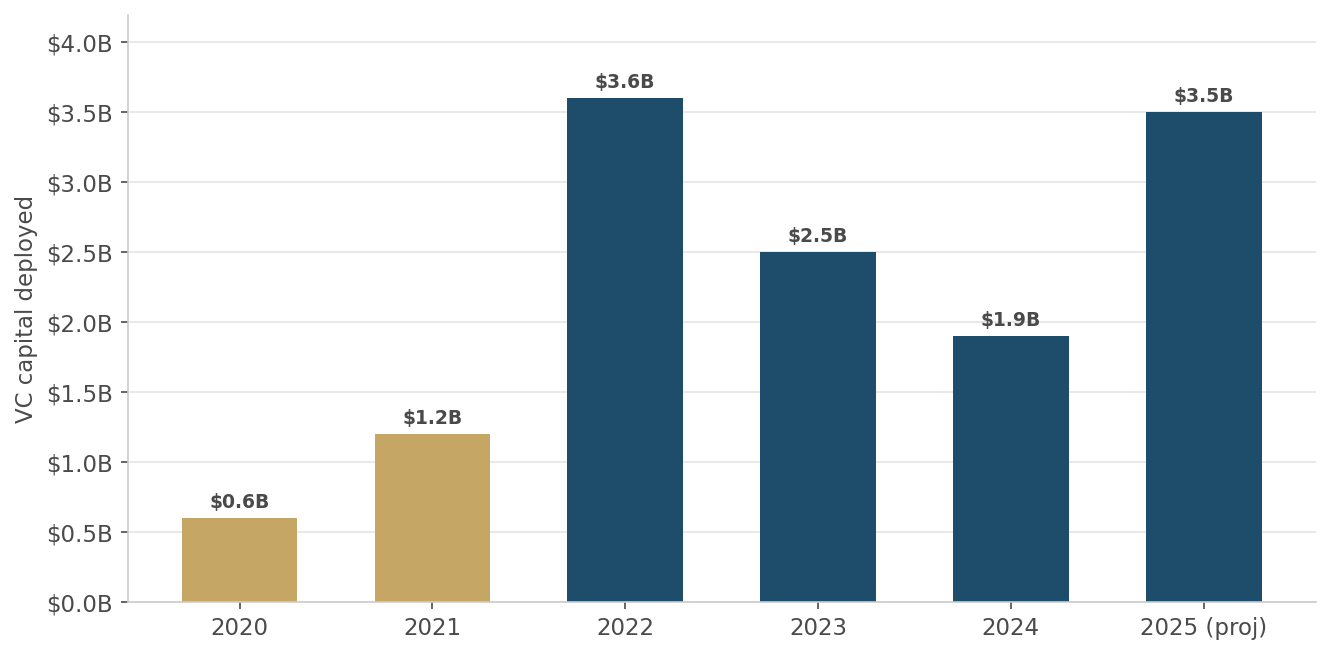
GCC Venture Capital Deployment, 2020–2025 • Source: PwC; MAGNiTT.
The Scale-Up Moment: When Founders Must Professionalise
There’s a predictable pattern in high-growth startups. Years 1–2 are about survival and validation. The founder wears every hat, makes every decision, and the company moves at the speed of human willpower. This works brilliantly — until it doesn’t.
Between months 18 and 36, as revenue scales and headcount grows to 15–30 people, the bottleneck shifts from product-market fit to organisational fit. Your CEO can no longer review every hire, approve every expense, or settle every conflict. The data backs this up: startups that professionalise their leadership during this window scale significantly faster than those that delay.
Russell Reynolds Associates reported a seven-year high in CFO appointments globally in 2025 — 316 incoming CFOs, with the S&P 500 alone hiring a record 106, up 19% on the year before. The signal is consistent across markets: experienced finance leaders are in acute shortage, and the GCC market is even tighter, where expat benefits and family packages can push total compensation 60–80% higher.
The First Five Hires: Your Leadership Blueprint
Not all executives are created equal. Some founders hire their college roommate as COO, then wonder why the company can’t scale. Others bring in an SVP from a Fortune 500 company who insists on building 15 committees and kills momentum. The key is understanding both the sequence and the profile for each role.
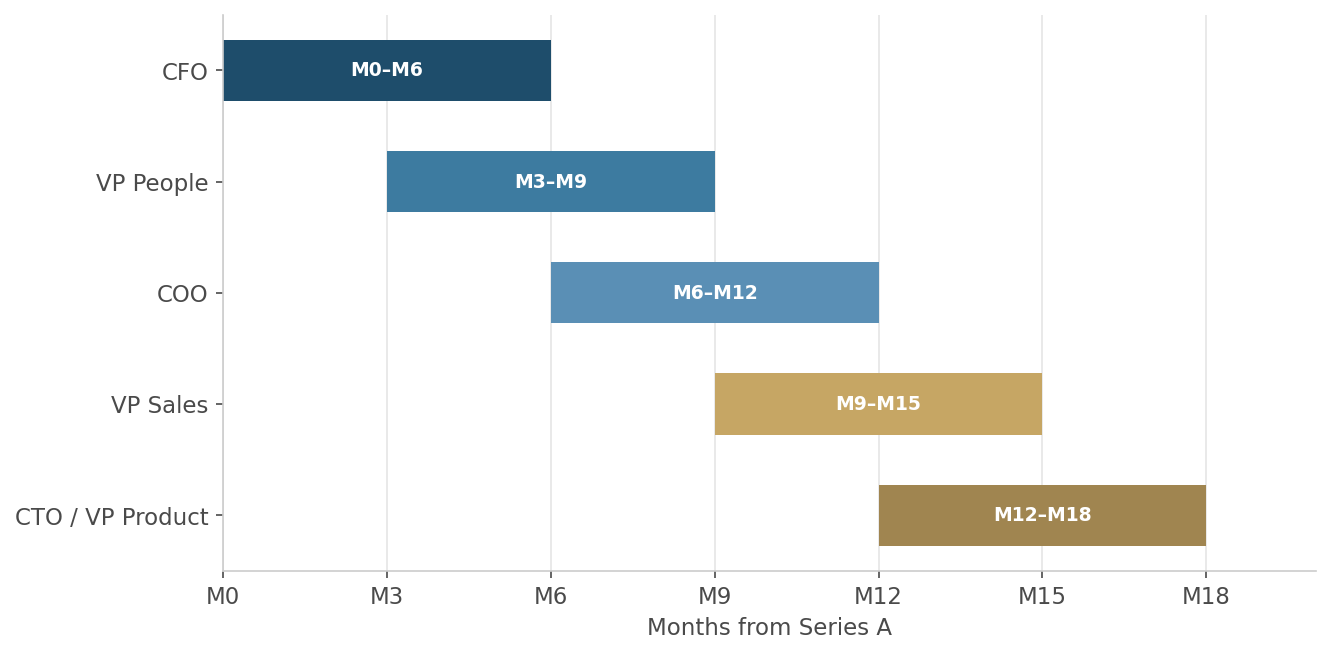
The First Five Hires Framework • Typical hiring window for each role, mapped against months from Series A.
1. Chief Financial Officer (CFO) — Hire First
Your first executive hire should almost always be a CFO or Finance Head. Not because you need someone to reconcile ledgers, but because you’re about to make fundraising decisions that will define the next 3–5 years of your company.
A strong CFO does three critical things: builds financial models that feel real, not optimistic; opens doors to institutional investors through credibility and relationships; and creates the early systems for cash management that prevent the "we ran out of money and didn’t see it coming" crisis that kills 40% of growth-stage companies.
What to look for: Someone with startup fundraising experience (not big-company finance). Ideally, they’ve been through at least one Series A. In the GCC, prioritise those with experience in Saudi Arabia and the UAE — government relations and VAT compliance carry real weight here.
2. VP of People / HR — Hire Second
Once you’ve secured your Series A and team headcount is hitting 15–20, your next hire is VP of People. This is where culture either gets intentional or dies.
The VP of People designs the hiring process, onboarding programme, salary frameworks, and conflict resolution. They’re also the first line of strategy on visa sponsorship and expat policy — critical in the GCC.
What to look for: Someone with scale-up HR experience, not Fortune 500 HR. They should be able to move fast and build systems on the fly.
3. Chief Operating Officer (COO) — Hire Third
By AED 11–22M revenue, you need a COO who can make decisions without you. This is the person who owns daily execution, revenue operations, key partnerships, and the P&L discipline that keeps growth sustainable.
The common mistake: hiring a COO too early. If you do this at AED 1.8M revenue, they’ll create bureaucracy that kills the speed that got you here.
What to look for: Someone who’s been VP of Operations at a similar-stage company. They should have experience scaling supply chains, managing vendor relationships, building reporting infrastructure, and handling multi-country operations.
4. VP of Sales / Growth — Hire Fourth
If you bring in a VP of Sales at AED 3.7M revenue with no operational infrastructure, they’ll hire a team and build a pipeline that your company can’t support. You need operations and people systems first.
By AED 14.7–29.4M, you need someone to lead the commercialisation strategy. In the GCC, where relationship-driven business and government contracts are often critical, this person needs to understand both enterprise deal flow and the unique ecosystem of GCC business relationships.
What to look for: A sales leader with domain expertise in your sector. Pick someone who’s sold in GCC markets before.
5. CTO or VP of Product — Hire Fifth (or Earlier if Product-Critical)
This is the one role with timing flexibility based on your business. If you’re a deep-tech or hardware startup, move this up to position 2. If you’re a services or marketplace business, this might come later.
A VP of Product scales your feature roadmap and competitive positioning. A CTO scales your engineering team and technical strategy. Both prevent the founder from becoming the bottleneck on product decisions.
What to look for: Someone who’s led product at a company in your category doing AED 36.7M+ ARR. In the GCC ecosystem, look for leaders who understand the unique product needs of MENA markets.
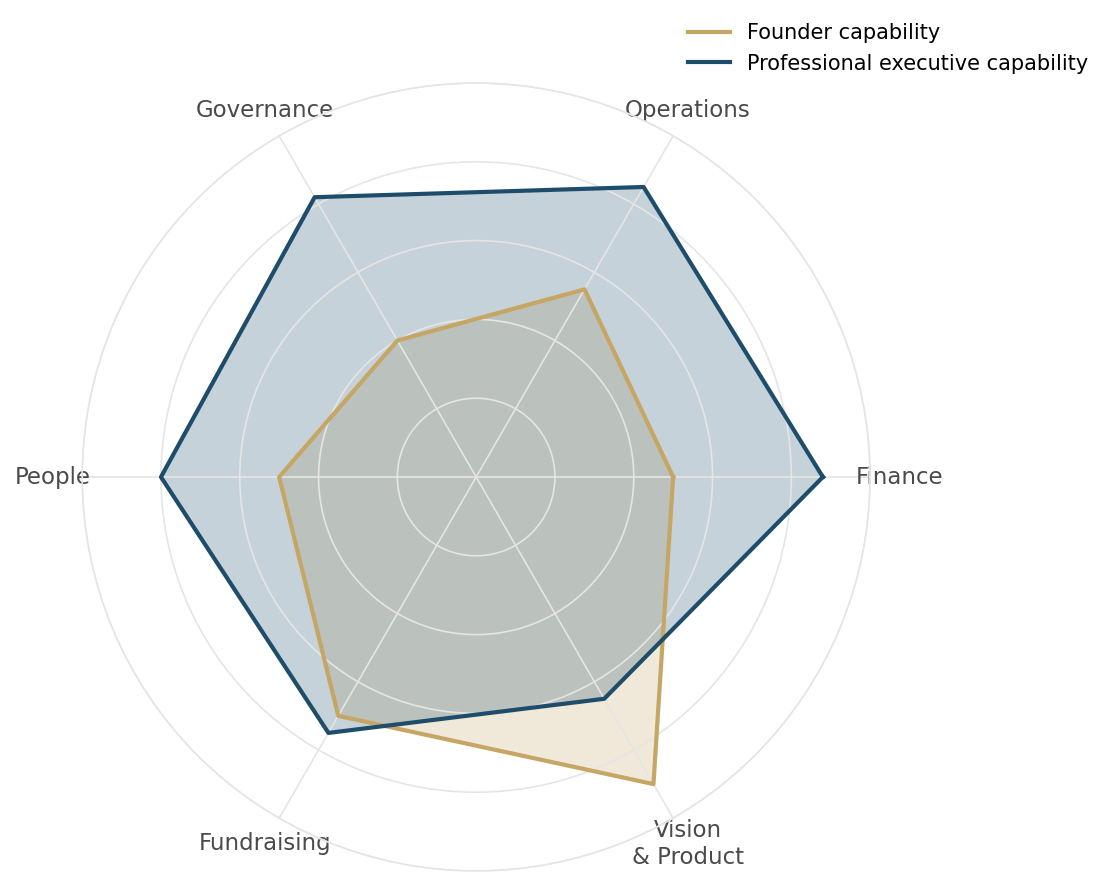
Founder Capability vs Professional Executive Capability • Source: RydeQuest analysis.
The GCC Factor: Hiring in a Concentrated Talent Market
None of the above applies universally in the GCC. The region has unique structural advantages and dynamics that change the hiring blueprint.
The concentration is real: Saudi Arabia and the UAE together dominate over 90% of regional deal volume, with Saudi accounting for the majority share of MENA VC funding in recent years. This means your hiring pool is concentrated, but your customer base might be distributed.
Visa sponsorship and expat strategy. In the GCC, visa sponsorship is a core part of the offer. An experienced global CFO might take a lower salary but expect a family visa package worth 40–60% of base salary.
Government relations and regulatory navigation. The GCC has sector-specific incentives — cleantech subsidies, fintech licences, healthtech partnerships with hospitals. In Saudi Arabia, connections with ARAMCO, PIF-backed companies, and government procurement are often where the real revenue is. In the UAE, Free Zone advantages and international banking relationships matter enormously.
Sector concentration. E-commerce, fintech, healthtech, cleantech, and sportstech dominate the GCC startup ecosystem. Hire sales and product leaders with domain expertise.
The Five Mistakes Every Founder Makes
Mistake #1: Hiring the wrong COO too early. Don’t hire for the company you are. Hire for the company you’ll be in 12 months.
Mistake #2: Promoting your founding team member into leadership. Technical excellence doesn’t equal leadership excellence. Invest in management training early, or hire managers from outside.
Mistake #3: Hiring big-company executives who can’t adapt. In the GCC, this is amplified because expat packages are non-trivial. Vet for adaptability, not just credentials.
Mistake #4: Ignoring the people / HR function until conflict happens. Build people infrastructure before you need it, not after.
Mistake #5: Not accounting for GCC-specific considerations. Hire for context, not just competence.
Your Action Plan: The 18-Month Hiring Roadmap
- Months 0–6: Hire CFO. Focus on financial credibility and fundraising support.
- Months 3–9: Hire VP of People. Build culture and hiring infrastructure.
- Months 6–12: Hire COO. Build operations and execution discipline.
- Months 9–15: Hire VP of Sales / Growth. Professionalise go-to-market.
- Months 12–18: Hire CTO or VP of Product. Scale technology and product strategy.
Great companies aren’t built by great ideas alone — they’re built by great teams. The decision you make today about your first CFO, your first COO, your first VP of People will determine whether your company is still shipping in 5 years.
The window for making these hires is narrow. Do it too early and you’ve built bureaucracy. Do it too late and your team is already fractured. Do it right — with clarity on who you need, what profile works, and how to build infrastructure around them — and you’ve just unlocked the next phase of growth.
Ready to Build Your Leadership Team? RydeQuest helps GCC scale-ups identify, attract, and integrate the executive leadership their next stage demands.