
One Page or Two? CV Length Rules for Early-Career Professionals in the GCC
By RydeQuest | Career Advice for Young Professionals in the GCC
Few CV questions generate more anxiety — or more conflicting advice — than this one.
Your university careers advisor said one page. A friend told you two pages looks more serious. A blog post you found online said three pages is fine for senior roles. Someone on LinkedIn said the whole idea of page limits is outdated.
So which is it?
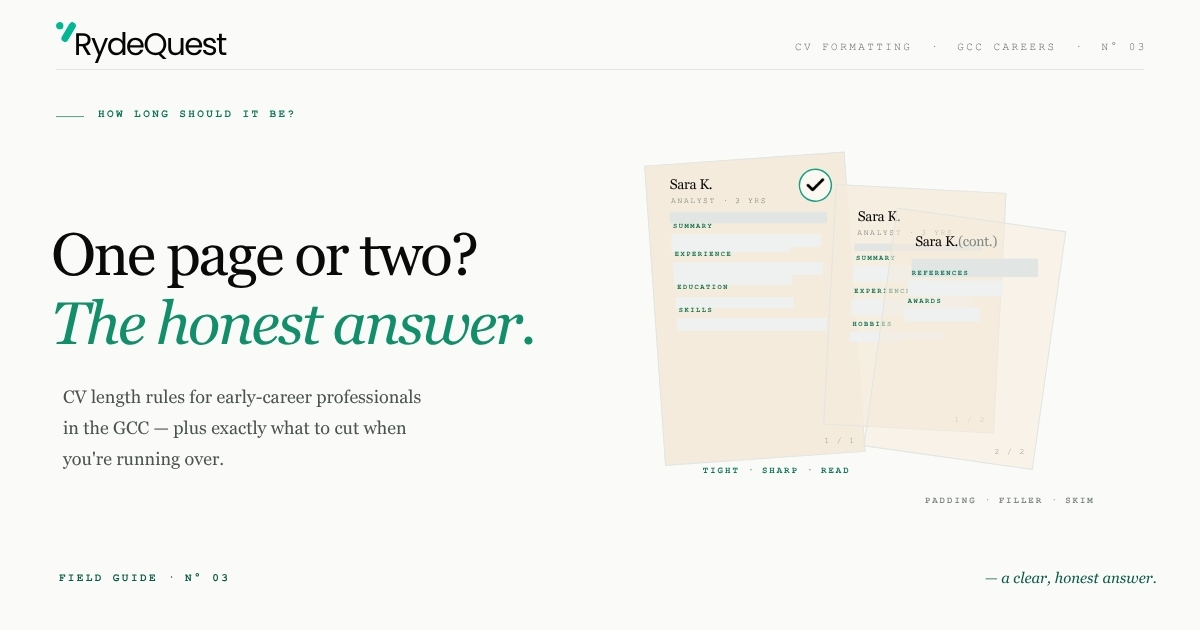
The honest answer is: it depends on where you are in your career. And if you're early in yours, the answer is almost always one page. Here's why — and here's exactly what to do with it.
Why One Page Is the Right Call Early in Your Career
Recruiters and hiring managers are busy. When they open a stack of CVs, they're scanning — not reading. Studies consistently show that initial CV reviews often take less than 30 seconds. In that window, a recruiter is forming a first impression: Is this person relevant? Are they organised? Can they communicate clearly?
A two-page CV from someone with two years of experience or less sends an unintended message: that you haven't yet learned to prioritise information. It suggests you're including everything because you're not sure what matters.
One page, done well, sends the opposite message. It says you know what's relevant, you can edit, and you respect the reader's time. These are qualities that employers actually look for — especially in junior hires who will need to produce clean, concise work.
The GCC Context: Does It Change Things?
Slightly, yes. A few regional nuances worth knowing:
Arabic CVs sometimes run longer. If you're submitting in Arabic — particularly for government, semi-government, or public sector roles in the UAE, Saudi Arabia, or Qatar — a slightly longer format is common and accepted. Don't pad it unnecessarily, but don't feel forced into a single page if the content is genuinely relevant.
International companies operating in the GCC tend to follow global norms. If you're applying to a multinational, a Big Four firm, a global bank, or a regional branch of an international company, lean toward the same standards used in the UK, US, or Europe: one concise page for early-career professionals.
Photo expectations vary. Some GCC employers still expect a professional headshot. Others don't. If a job posting doesn't mention it, leave it off. If it does, include a small, professional photo — not a casual selfie.
When Two Pages Might Be Justified (Early Career Edition)
There are a handful of situations where two pages can be appropriate even at a junior level:
- You have multiple significant internships across different industries and there genuinely isn't room to represent them fairly on one page
- You're applying for a highly technical role (engineering, data science, architecture) and your project portfolio, certifications, and technical skills genuinely require more space
- You're submitting a CV in Arabic for a government or semi-government role where longer formats are standard
- A recruiter or the job posting explicitly asks for a full CV rather than a resume
In any of these cases, a clean two-page CV is fine — but only if every line earns its place. Two pages of substance is always better than one padded page or two pages of filler.
What to Cut When You're Over One Page
If your CV is spilling onto a second page and you can't see why, here's what to look at first:
Cut the obvious:
- "References available upon request" — this is understood. Remove it.
- Objectives or mission statements that are entirely about what you want
- Every subject or module you studied at university
- Skills that are expected and not worth stating (e.g., "proficient in Microsoft Word" for most roles)
Tighten your bullet points: Most people write bullet points that are too long. If a bullet runs to two lines, ask yourself if it can be said in one. Usually it can. Cut adverbs, remove filler phrases like "responsible for" or "tasked with," and get to the point faster.
Remove irrelevant experience: A part-time job from five years ago in a completely unrelated field might not need to be there if it's the thing pushing you onto a second page. Keep what's relevant; let go of what isn't.
Adjust margins and spacing — carefully: There's nothing wrong with reducing margins slightly or adjusting line spacing to gain a little room. But don't go so small that the CV becomes hard to read. A 10pt font with 0.5cm margins and no white space is not a one-page CV — it's a wall of text.
A Practical Test: The Squint Test
Here's a simple way to evaluate your CV's visual balance. Open it on your screen, then step back or squint so you can no longer read the words — just see the shapes.
What do you see? Is there a clear structure with natural breathing room? Or is it dense and grey with no white space?
If it looks crowded even when you can't read it, it will feel crowded to a recruiter who's scanning it in 20 seconds. Fix the layout before you fix anything else.
The One Rule That Overrides Everything
Whatever page length you choose, every line on your CV should earn its place. Ask of each bullet point, each section, each line: Does this make me a more compelling candidate for this specific role?
If the answer is no, cut it — regardless of whether you're on page one or page two.
A focused, relevant, well-structured one-page CV will outperform a padded two-pager every single time. Quality over quantity is not just good career advice. In this case, it's the point.
RydeQuest is a boutique executive search and HR advisory firm based in Abu Dhabi, serving organisations across the GCC. Follow us for more career insights, or get in touch at rydequest.com.