

EXECUTIVE SEARCH · GCC
The True Cost of a Wrong Senior Hire in the GCC
The Hidden Crisis in Your C-Suite
A Fortune 500 executive joins your organisation with impressive credentials and a stellar track record. Eighteen months later, they’re gone. The strategy they championed is shelved. Three key team members have departed. Investor confidence has wavered. And you’re facing a bill that extends far beyond the severance package.
This scenario plays out far more often than most boards care to admit. Research from the University of South Carolina’s Center for Executive Succession reveals that over 40% of executive hires fail within the first 18 months. In the Gulf Cooperation Council — where executive compensation packages reach AED 1.1M–2.9M+ with housing, schooling, and relocation allowances — the stakes are astronomical.
The core truth: industry research consistently shows that a single mis-hired executive can cost an organisation up to 10 times their annual salary, not counting the compounding damage to strategy, culture, and stakeholder relationships. Yet most organisations measure executive hiring success by recruitment fees and onboarding velocity. They miss the true cost entirely.
The Visible Costs: Direct Financial Impact
Begin with what you can calculate. When an executive hire fails, the direct financial costs compound quickly:
- Salary and benefits waste: 12–18 months of executive compensation — in the GCC, easily AED 1.5M–5.5M before benefits.
- Severance and exit costs: End-of-service gratuity, visa processing, and repatriation costs.
- Recruitment costs: The search firm retainer, advertising, background checks, and assessment tools.
- Replacement hiring: Starting the search all over again.
Research shows these direct costs vary by seniority level. A VP departure costs 2–3 times annual salary; a C-suite failure reaches 5–7 times salary. For a CEO exit, the multiplier can exceed 10x.
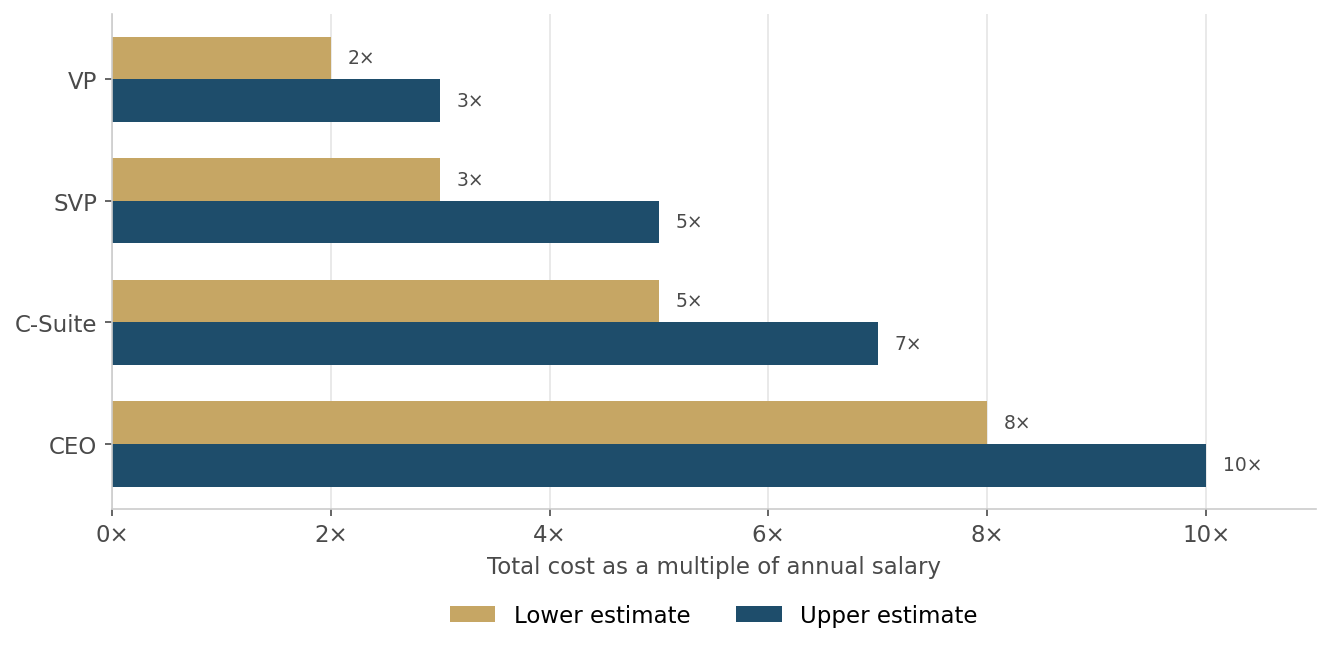
Cost Multiplier by Executive Level • Source: Harvard Business Review; University of South Carolina.
CHRO surveys consistently estimate the direct cost of a failed external executive hire in the multi-million-dirham range, with the most senior failures running into double-digit millions. And this data reflects Western markets, where salaries are often lower than Gulf-region compensation packages.
The Hidden Costs: Culture, Strategy, and Trust
The far greater damage occurs in domains that resist quantification. When an executive hire misaligns with your organisation’s culture and strategic direction, the ripple effects cascade across the entire system.
Operational disruption. Strategy is stalled as the new executive’s vision conflicts with established direction. Quarterly initiatives are reset. Resources are reallocated to "fix" problems the previous leader never identified. In knowledge industries, this can mean 6–12 months of lost momentum — momentum that competitors don’t forgive.
Talent haemorrhage. When an executive fails, the highest performers on their team leave first. They have options. They find those options. One failed hire cascades into 3–5 additional departures, each carrying with it institutional knowledge, relationships, and momentum.
Culture erosion. A misaligned executive actively damages organisational culture. Mismatched values, clashing communication styles, and misaligned incentives create friction that spreads. Engagement drops. Psychological safety deteriorates.
Stakeholder trust. In the GCC market, where networks and relationships drive business, a failed executive hire signals to investors, partners, and customers that your organisation may lack judgement at the top. Recovery of that trust takes years.
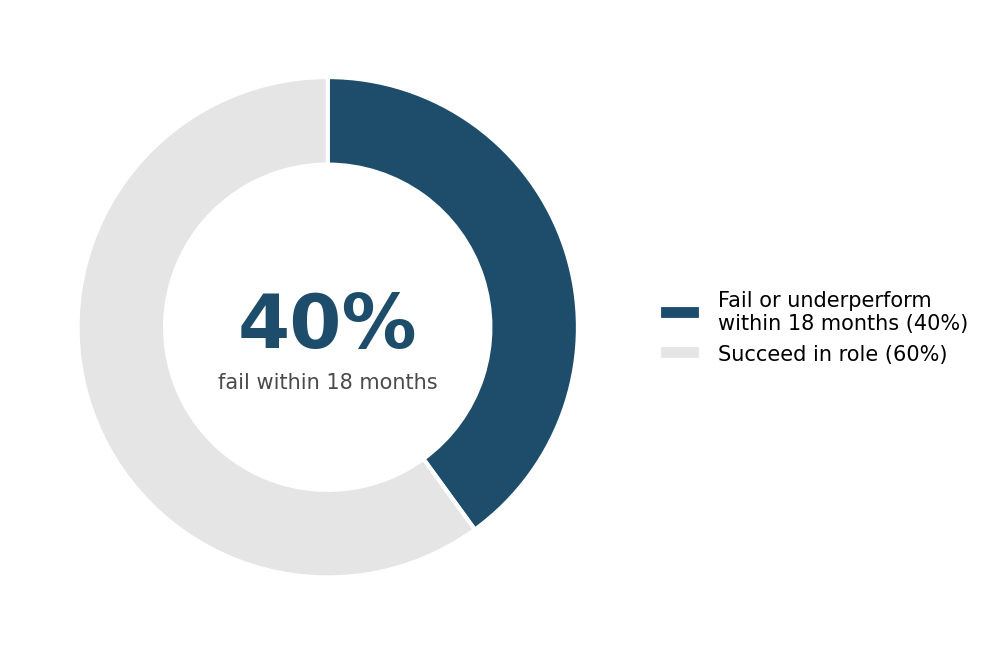
Executive Hire Outcomes Within 18 Months • Source: University of South Carolina Executive Search Study.
Research from the Center for American Progress suggests the true cost of replacing a senior executive can reach up to 213% of the position’s annual salary when you account for all direct and indirect losses. That’s nearly 2.5 years of salary for a single failed hire.
Why Senior Hires Fail Specifically in the GCC
The Gulf market has its own dynamics, and understanding them is critical.
Geographic and cultural transition. A brilliant executive from London or New York arrives in Dubai, Riyadh, or Abu Dhabi with a track record of success. But they’ve underestimated the texture of relationship-driven markets. Decision-making rhythms are different. The pace feels simultaneously faster and slower. Six months in, they’re frustrated. Twelve months in, they’re planning their exit.
Compensation expectations vs. performance. The GCC attracts top talent partly through exceptional compensation packages. Yet organisations sometimes hire the candidate who negotiated hardest on salary rather than the candidate who demonstrated cultural and strategic alignment.
Visa and family factors. Decisions move faster in the GCC because visa structures and family logistics compress decision timelines. What might be a 12-month tenure question in Europe often becomes a 9-month one in the Gulf — which is why preparation, integration, and early signals matter more here than almost anywhere else.
Network concentration. The GCC’s executive market is concentrated and relationship-driven. A failed hire doesn’t just cost you the individual; it shapes your reputation in a network where everyone knows everyone.
The Compounding Effect: Ripples Through the Organisation
A single failed executive hire doesn’t create damage that stays contained. It spreads.
Secondary exits. When the executive leaves, 2–3 of their direct reports typically follow within months. Each of these departures carries a cost of 50–150% of annual salary. A failed C-level hire can therefore trigger AED 3.7M–7.3M in additional exits beyond the primary failure.
Strategy whiplash. The previous strategy is abandoned. The new executive’s strategy is implemented. Eighteen months later, that strategy is shelved and the board is searching for a new leader. Frontline teams experience three different strategic directions in 24 months.
Lost hiring windows. In fast-moving markets like GCC tech and finance, timing is crucial. A failed executive hire delays critical hiring, product launches, or geographic expansion by 9–12 months. That delay may cost the organisation market share that never returns.
Board and investor confidence. One failed executive hire is an incident. Two failed executive hires in three years is a pattern. Investors begin to question whether your organisation can execute at scale.
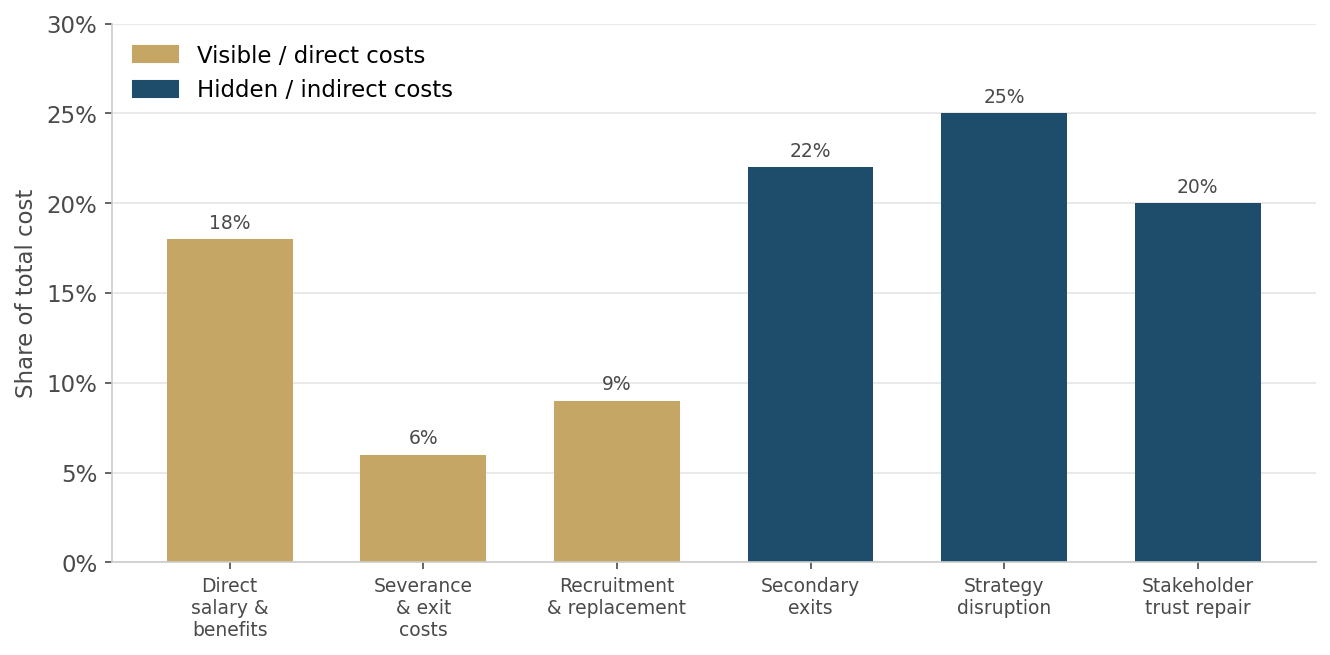
The Hidden Cost Breakdown of a Failed Executive Hire • Source: Center for American Progress; RydeQuest analysis.
A Better Approach: Mitigating the Risk of Executive Failure
Given these realities, the traditional executive search model — where a recruiter finds qualified candidates and a hiring manager selects based on interview chemistry — is insufficient. The cost of failure is too high.
- Principal-led evaluation. The board chair, CEO, and key stakeholders engage directly in final-stage evaluation.
- Structured cultural assessment. Use structured tools to evaluate values alignment, decision-making style, and leadership philosophy.
- Reference depth and regional intelligence. GCC hiring requires specific regional intelligence and references from those who’ve worked in similar markets.
- Integration planning before day one. Outline stakeholder relationships, strategic priorities, and cultural touchstones before the executive arrives.
- Extended evaluation windows. 90–120 days allows deeper reference calls and stakeholder interaction. The investment in time saves ten times that investment in failed hire costs.
The cost of a thorough executive search pales in comparison to the cost of a failed hire. Yet many organisations rush to fill the role rather than invest in finding the right one.
The True Measure of Executive Hiring Success
Success in executive hiring isn’t measured by how quickly you fill a role or how impressive a candidate’s resume appears. It’s measured by whether that executive, 18 months in, is delivering strategy, retaining talent, and strengthening your organisation’s culture and reputation.
In the GCC, where exceptional compensation packages and concentrated talent markets amplify both the cost and consequences of failure, getting this right isn’t a nice-to-have. It’s a core business function.
Every percentage point improvement in executive hire success — moving from 60% to 65% to 70% — translates to millions of dirhams in protected value. The question isn’t whether you can afford to invest deeply in executive hiring. The question is whether you can afford not to.
Ready to Strengthen Your Executive Hiring Process? RydeQuest partners with Gulf-region organisations to build executive search strategies that reduce failure risk and accelerate success. From principal-led evaluation to cultural alignment assessment, we help you hire executives who drive strategy.